
Happy fourth birthday to Grubbery, happy 12-year Facebook friendversary to my sister, and happy book release-spring to her too.
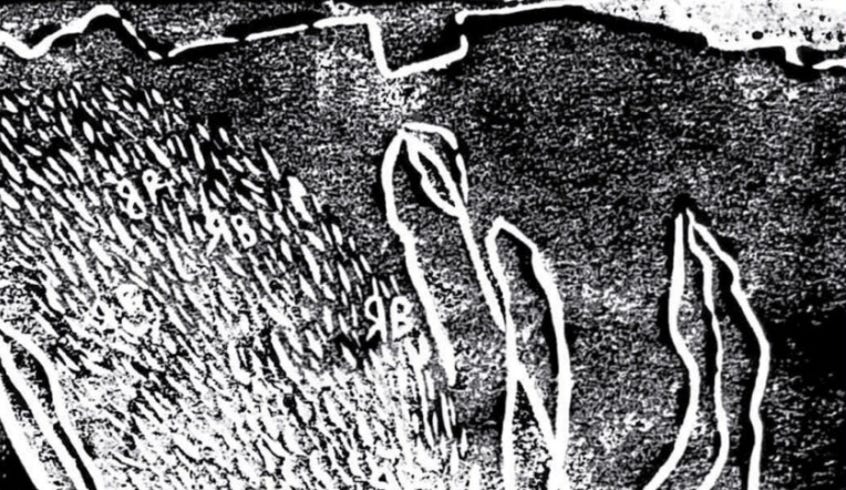
And this is something which happens whenever Eva and I take a long walk together; that two-thirds of the way through, she will begin to look vacant, and do a little shake, and I will ask if she needs to sit down. Most of the time we walk in summer, in Brisbane for Christmas, or Stradbroke Island, Minjerribah, for New Years. For some reason, the logic of the shakes is inconsistent—if she hasn’t had a snack, she gets them, and if she has, she gets them too. If we have had a coffee—a cold, plastic-cup iced latte, she will never get a long black—they are reliably worse.
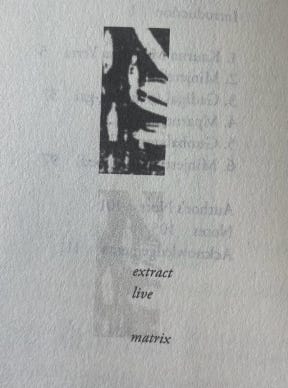
How I laughed, then, when coming to this page of her new book:
Close to Christmas, I stand on the edge of the lookout at Mt Lofty, trying to find the beginning of St Vincent Guld. In front of me, Adelaide gently sprawls, shining in sun after days of unseasonable rain and chill. I am boiling, sweating, shaken by the sugar of my apple snack (14).
Really, who else would be so affected by the glucose hit of an apple, to then render it in sibilance. Only my perfect sister.
Eva’s first book of poetry was released on the 1st of September, the beginning of spring. She, as a person, has much in common with this season (although she would say, No, summer). She is a delight of regeneration and all the flowers bloom for her. Her book is called borrow or rob; it was published with UQP, after the manuscript was awarded the Thomas Shapcott Prize in 2024. For the most part, it is addressed towards the modernist artist Margaret Preston, her relation to Indigenous communities, and her “taking up” of facets of Indigenous art, as a white Australian. The second level of Eva’s critique is directed at the reception of Preston; including institutional and critical discourses, and Preston’s own written defence of her practices.
As Eva writes it:
Preston was committed to her own idea about building a “national Australian art” that combined Western techniques with other approaches she saw as specifically “Australian”. Travelling to remote Aboriginal missions throughout her life, [she] began producing works that directly lifted significant motifs from Aboriginal art, all in the name of developing a national art drawn from “our” Aboriginal peoples (2).
Eva’s questioning depends on the “from”; white modernists developing newness in art from a cherry-picked assortment of Indigenous artistic practices; producing an idea of the nation from the imagery of the people whose genocide was its founding.
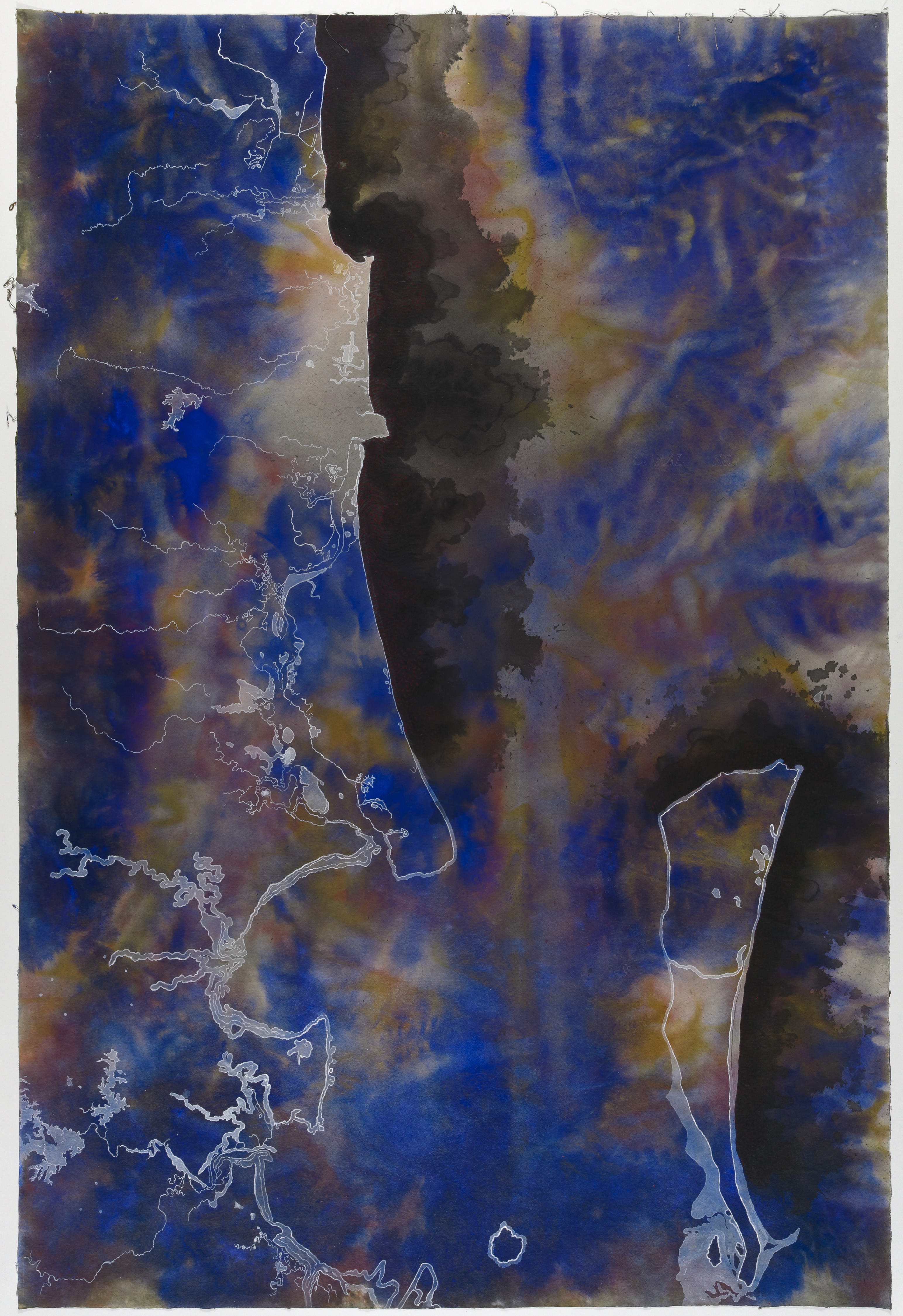
However, Eva begins borrow or rob not with this critique, but with a portrait of our dad.
Printmaking as storytelling has been a long time coming: for most of my life, I have watched my father prepare screens, chop wood to build reliefs of negative space and curving, reflective shapes. Our house was small, so when he wanted to work, he would use our dining area, two long wooden tables end-to-end on a concreted outdoor slab (1).
I remember pulling the squeegee along the silk screen, and then standing back as Dad sighed. You have to press harder. Tears, I can’t, I can’t. None of us were trained to be printmakers, or artists—I tried, and then gave up—but of the three of us, Eva was the most honest about wanting to remain close to art. However, as much as hers is a book about printmaking, it is still a work of poetry and prose (and is, therefore, as much about language as anything else).
Much of Eva’s diffuse literary inheritance came first from our mother, which is a harder thing to describe, because in childhood this shared relationship to language became an invisible, organic atmosphere.
The other day, Aaron’s workmate asked him about my life—who my siblings are, what they do. He told them that I have two older siblings; a brother, who is a senior public servant, and a sister, who is a teacher and a poet. She asked him what my parents did. Well, her dad is an artist, and her mum is an architectural historian. That makes sense, she said. Sure, I guess. Your family are your first universe, and the first delimiting of possibility. Not much can change that, until you’re older.
*
Preston, like most modernists, is obsessed with knowledge. It is this obsession which makes her art at once exceptional and almost reflexively exploitative—because knowledge is also a resource. As she puts it, Would France be now at the head of all nations in art if her artists and craftsmen had not given her fresh stimulus from time to time…from the art of her native colonies…[and] by borrowing freely from the colonies of other countries? (1925; qtd. by Eva, 10). When Preston describes Indigenous made “shields”, they are rendered neither useful nor historical; instead, they are resource-holding vessels, out of which “designs” can be yielded (52). But Eva’s quotation of this is also discomforting—for what artist doesn’t find themselves implicated in that core desire; to yield something out of another? To see yourself as a picking bird, fidgeting through matter to find what works.
A modernist artist, so concerned with the liberatory potential of form, has to understand that their desire for newness is something sick. It is necessary, and it is a motor, but it is also something sick, anchored in the bay / untenable Oh how we want to expand! they / cried (44).
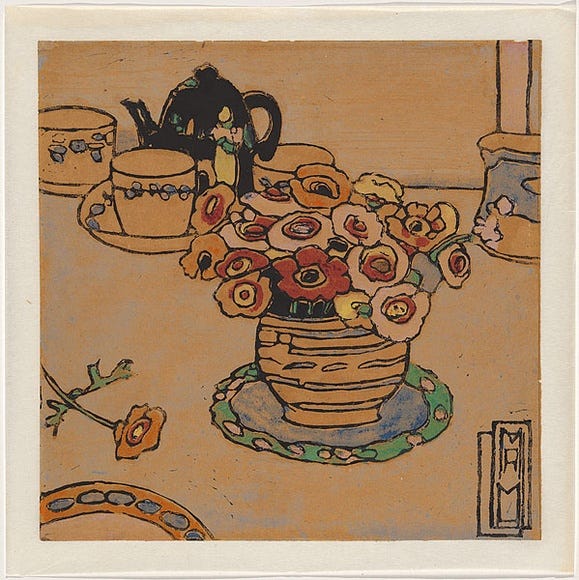
Eva’s first stanza of her own poetry is a kind of naïve ekphrasis of Preston’s Still life and flowers (1916–19): I am a teacup, slowly rotating / until you / might see all my sides….Beside me, two / more of me, shod in saucers handles / hidden behind.
You are a teacup, given childlike voice, and I am the viewer, moving you around to see one side, then another. The naïveté of your voice reminds me of the innocence ascribed to colonial artists—that they were/are simply wandering as happy, hapless children through a world of aesthetic experience. I’ve always thought that this doesn’t come close to describing the bloodthirsty, competitive element of artmaking—which is not new; which has existed for a very long time. Same goes for the relationship of the artwork to the commodity form.
Later, Eva will tell us that Still life and flowers exemplifies Preston’s attentiveness to Japanese print techniques; that the single-block, hand-coloured gouache print is stamped with Preston’s maiden initials—MRM—shaped in the style of a Japanese seal (39).

The teacup returns, bleeding into a later work; flora with joke of my seedpods (32):
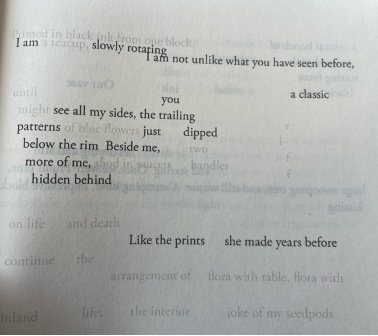
Faded difference in typography can feel gimmicky or false, but here it is essential to the bleed and its repetitions. The letters in lighter-grey come to represent something like the gap in understanding between the land, its symbolic representation in Indigenous art, and its re-representation by Preston, then Eva.
In her introduction, Eva writes that,
I could find no evidence of Preston’s concrete consideration for Aboriginal peoples. I set about building a project that moved through the places that Preston visited, responding in turn to her own works and the violent colonial histories of these places, layering, redacting and flipping the images and stories as a printmaker would, and did.
Flipping suggests inversion, which has the potential to be unsatisfying—semantically, borrowing is not the inversion of robbing. Rather, when reproduced at the level of colonisation, the confusion of their similarities becomes a horror; becomes another extension of violence done in, by, and to cultural forms. But this is why Eva’s title is a palindromic flip—borrow or rob, bor ro w/ or/rob; they meet in the middle, the words are mirror to one another.
Eva spends two parts of the book (the second and the last) on Minjerribah—the island of our childhood summer holidays, blissful white, hot, sand:
I first encounter Preston’s “West Australian banksia (1929)” in a small fibro room on Minjerribah…I am maybe five years old…On a single block of land on the hill that elevates the Point Lookout Lighthouse, two houses sit snugly side-by-side, their proximity assuming friendship between the residents…[But] I know these houses are owned by a collection of people to whom we only symbolically belong.
The print hangs in the lounge room-kitchen of the smaller house, a place so full of sharp corners, exposed stairs and unlevel ground that we have not stayed there since my sister was born. It sits on the wall that is not windowed, doored or damaged, but illuminated at night by a paper lantern propped on the table below. The singularity of this print—as the only piece of art in the room—lends it icon status, its contents only adding to this feeling (24).
That work still hangs there; we see it every year, in the week between Christmas and New Year. The two of us sleep just below it, in flat daybeds beside the tiny kitchen. Arriving Boxing Day afternoon, key in the lock, and the shed’s green doors open outwards, forming a perfect frame for Preston’s print as it greets you. We have always said, this is The Most Beautiful Place in the World.
The leafy extremities of [her] banksia bouquet are crab-leg-like, crackling green limbs, upward turned, which flip to black on their underside. The three peaks of thick white banksia rise from the tops of this middling forest layer, their lower halves already beginning to fur and dry. At the foot of the cylindrical black vase, two dried seedpods lie prostrate, their many eyes gazing upwards like alien Mary Magdalenes[1]. Cut from a single wooden block and printed with black ink, the greens, yellows and umbers of the arrangement have been added by hand, the white spots of the banksia flowers daubed onto the creamy Japanese paper. Victory, benediction, fecundity and land, cut and pressed in relief (24–5).
Eva remembers Pam—glorious, shimmering friend of our parents, always returning from a trip elsewhere—walking through the door with her paella, golden rice encrusted with technicolour Morton Bay Bugs, prawns, crabs, mussels and soft cubes of white fish (25). How strong and vivid these memories are, how bound up with sense and pleasure. The gratification of looking at Preston’s work, perfectly framed and isolated, had so much in common with the pleasure of looking at Pam in all her ornament, or the rare glory of the studded paella. I always felt so greedy.
We used to say that we would buy the house on the lighthouse hill—the whole hill, maybe—and protect it forever. Protect it from who?
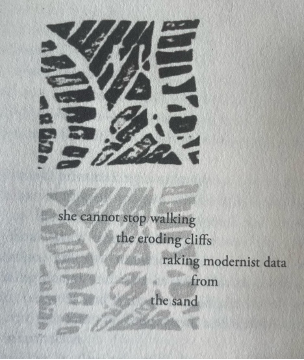
At the end of the book, Preston returns in the real body of a woman, wearing a straw hat tilted to the extreme, a collared cotton shirt, soft dark walking shoes (94) and she is the image of my indirect sister—for whom, People like to come at things diagonally, sit on things for a long time (93).
And then this final, masterful collection of images, the text’s real culmination:
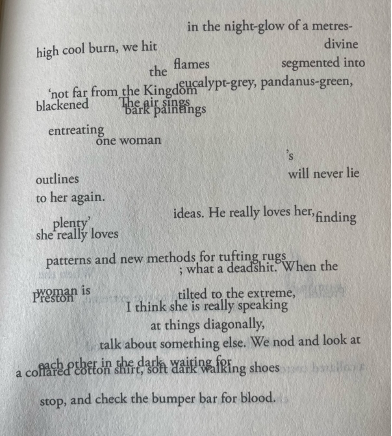

How tough and unyielding Eva’s conclusion is, checking the bumper car for blood. How many memories, hurts, and patches of blood are pieced together here, reformed into something which implicates her as much as anyone else. But she can hold it; just one of the toughest people I know, but so optimistic and open-hearted, so without bitterness or the gouging stupidity of self-pity—deadshit.
This combination of toughness and love means that Eva can bear her own devastating conclusion, even as it gestates in black ink / and death / the / life; / posthumous / round-stomached / that / is only buried a / short while (26).
But I can also see her walking past me, speeding to the edge of the boardwalk. Grinning and turning back to declare, Printed / on life / I continue / inland / cast as / knowledge that / dies / before it / begins again (23). I can see myself agreeing, and following her, because this sounds like something hopeful. And I might love the words, but I love her kindness best, which is just another expression of this unassailable hope.
Borrow or Rob is available to buy at all good bookshops.
[1] How wonderful, how awful!