Day Off

In Brunswick East, some people let their dogs off-leash. Over the last few weeks, I have met four dogs on the street and followed each of them anxiously, until finding an owner or acquaintance who could tell me that it was okay, because they like to roam. This really pissed me off.
Hungry and walking through Princes Park, I decided that I would cook the chicken again. By the road, there was a big chocolate spaniel sloping and dancing his way towards the fountain and the intersection. I was convinced that this time I would have to watch a dog die. The alternative would be running after him, again, until the deflation of, there’s nothing really wrong, no mistake. The drama was your creation; except it wasn’t, because dogs do die.
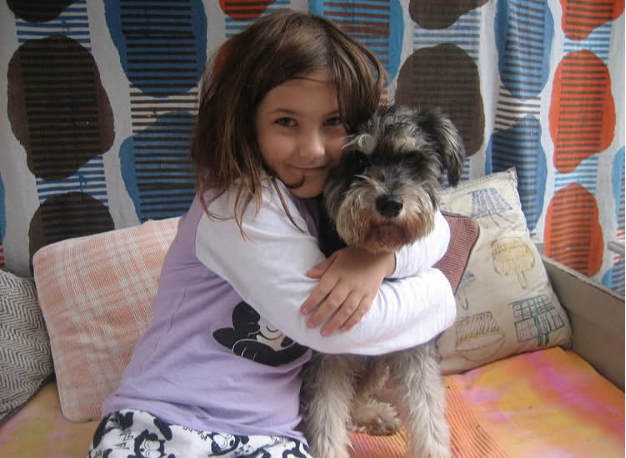
When Pippin died, my father so gently placed his body on the bed, and we lay our heads on his chest. He was buried at the end of the garden, and for the first time I understood what a spirit was. In dreams and in the doorways, I loved him and so he stayed.
Three years later, we found a new dog for our parents. Odo was, we were told, professorial and quiet—a scholar, we thought. We didn’t consider that some scholars are barking and impassioned. He and I spent a lot of time together, and for my last months in Brisbane, I was his mother. Now, when I dream about Pippin, or Odo, I dream about them together; as one dog. When it first happened, I thought that this was a shameful thing—that I had simply replaced one with the other and erased all the particulars of the separate loves. I don’t feel that way anymore.
Earlier this week, I dreamt that Pippin/Odo and I were passing through a city together. We sat on a stone floor and watched a film, and I realised that he was dying. He didn’t know, and I didn’t want him to be scared, so I sat quietly, feeling his body sicken and fail, but knowing that he didn’t feel any pain. He was my very good friend, and I wanted him to enjoy the movie.
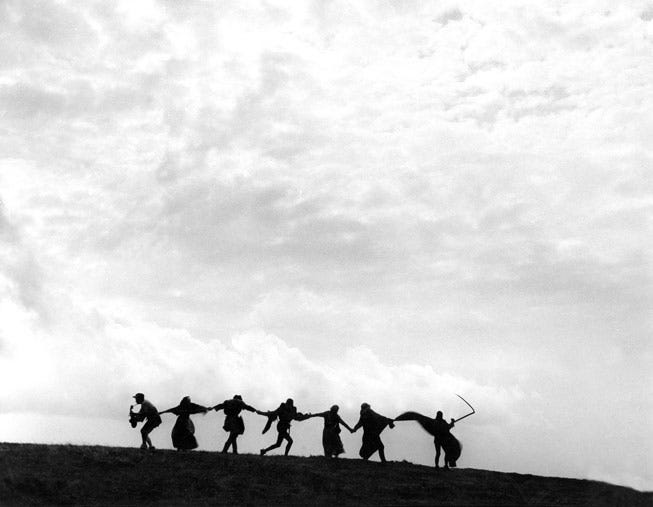
In The Seventh Seal, we are—and are not—responsible for the deaths of others; but we are always responsible for their lives. Much is made of the chess game between Death and his Knight, but the body of the film is that other thing; a little fat baby loved by his parents, the vicissitudes of love and marriage, or the young woman strapped to a ladder and burned.
The Knight, with his past of untold violence, can only give himself to death after first rejoining the world of the living. He lives long enough to reunite with the woman who loved him, then peacelessly (head in his hands) faces the necessary sacrifice so that others might go on. Not as total redemption, but as continuation. This runs contrary to our fantasies of the end being absolute, a wipeout, where the idea of dissolving at-once means not having to think the reality of catastrophic process.
In their final play, Death asks the Knight,
Did you gain by the delay?
Yes, he replies.
I am glad.
Before, stretched out on the grass, the Knight had said, I will remember this hour of peace. The dusk, the bowl of wild strawberries, the bowl of milk, Joseph with his lute.
Punching into my left breast, holding still, I started to cry.
Like all Ingmar Bergman films, The Seventh Seal is about the historical position of the artist. In his introduction to the published script, Bergman wrote,
…it is my opinion that art lost its basic creative drive the moment it was separated from worship. It severed an umbilical cord and now lives its own sterile life, generating and degenerating itself. In former days the artist remained unknown and his work was to the glory of God. He lived and died without being more or less important than other artisans; ‘eternal values’, ‘immortality’ and ‘masterpiece’ were terms not applicable in his case.
In comparison,
Today the individual has become the highest form and the greatest bane of artistic creation. The smallest wound or pain of the ego is examined under a microscope as if it were of eternal importance. The artist considers his isolation, his subjectivity, his individualism almost holy. Thus we finally gather in one large pen, where we stand and bleat about our loneliness without listening to each other and without realising that we are smothering each other to death. The individualists stare into each other’s eyes and yet deny the existence of each other. We walk in circles, so limited by our own anxieties that we can no longer distinguish between true and false.
His obsession with the sacramental is a nostalgia for any kind of moral-aesthetic imperative, shared with others. I would play, Bergman says, my part in the collective building of the cathedral. But of course, Bergman’s greatest works are a protracted encounter with his own, most keenly felt, wounds. And the result—an extraordinary aesthetic presentation of the encounter—is an account of life under ‘late modernity’ which has only been equalled a handful of times.
After the death of God and the moving scales of the last century, what can the artist do? It is near-impossible to bypass their reproduction of self as individual life; so instead they remain fixed on this life, while looking for something which could absorb and digest its alienation into a shared object of glory—or anything shared, at least. Even if the thing shared is real pain, prior to its degeneration.