Furniture in love
John Maynard Keynes and Duncan Grant

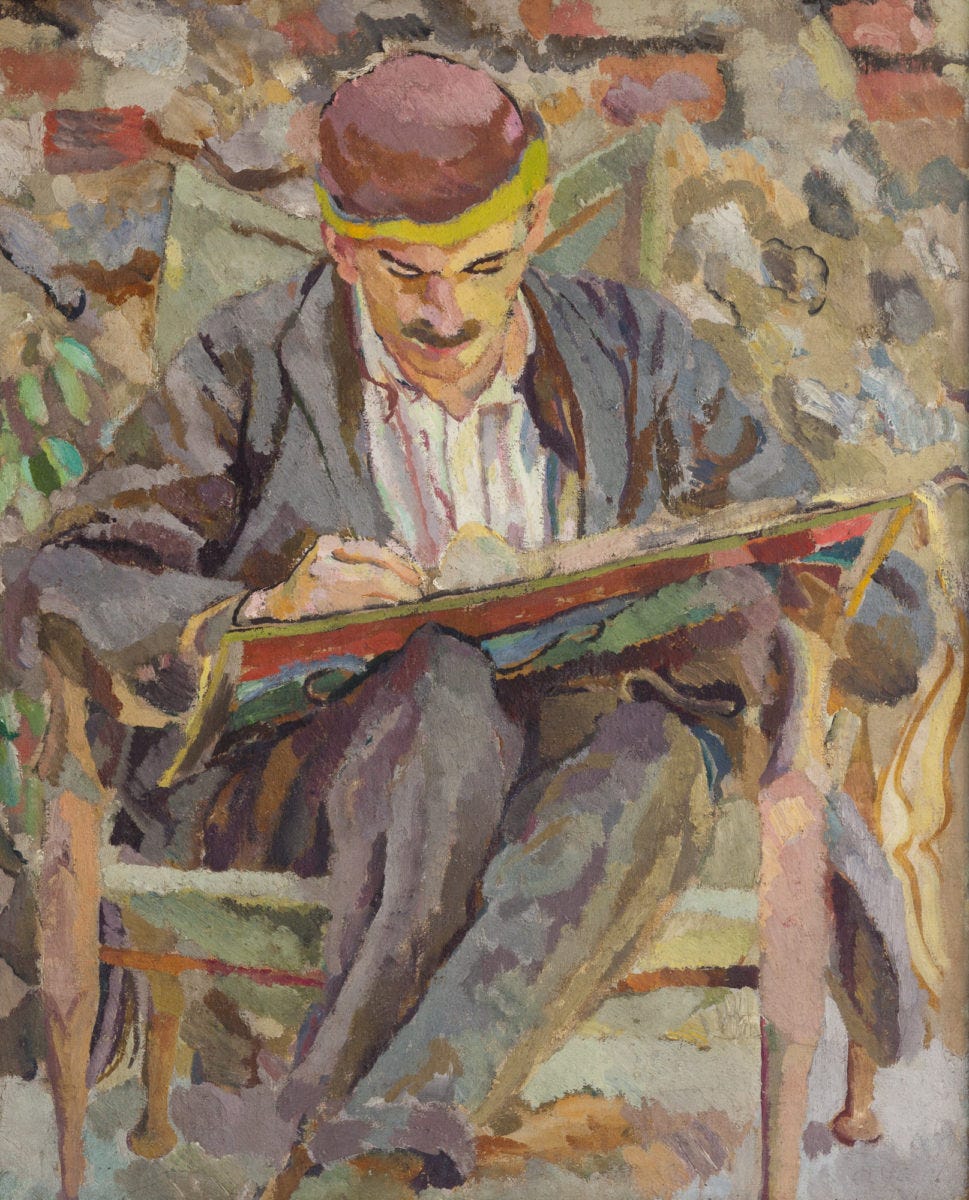
Can We Consume Our Surplus? Or, The Influence of Furniture on Love,
is the title of a paper given by John Maynard Keynes to a meeting of the Cambridge Apostles in November 1909. At 26, Keynes (not yet the century’s most important economist) was himself an Apostle—meaning that he was part of a small, select group of university men, who would meet to debate the good, the right, and the beautiful.
One of these men was George Edward (G.E.) Moore; ten years older than Keynes, and the philosophic head of the group. In Moore’s most famous book, Principia Ethica (1903), he had argued for the impossibility of defining the good in ‘natural terms’ (i.e., classifying a thing as good because it brings the most happiness). Instead, we must understand goodness through its embodiment in various states—states of pleasure, beauty, friendship, and knowledge. In this understanding, ‘goodness’ remains whole, unreduced to parts.
At the end of Principia Ethica, Moore singles out two reliable apparitions of the good:
1. Meaningful human relationships and their pleasures;
2. The love and appreciation of beauty.
These apparitions go skipping and jumping through The Influence of Furniture on Love.
Keynes begins his address, like all debates, with a topic.
The influence of furniture upon love is a subject which ought properly to be treated in an historical way by the Moderator.
He builds an image of Cambridge as present historical situation, moving between judgements of its colleges, their rooms, views, and suitability for intellectual work.
The shape of the rooms, however, seems [most] important to one’s calmness and the flow of ideas in work…It is difficult to be at ease in a very high room or in one which is crowded with a great variety of objects.
This is all play, though, before he can return to the question of greater seriousness:
In what sort of rooms does one fall in love? Take this room, for instance. Could any human being hope to fall in love here? There is nothing very aphrodisiac, is there? Chintz within walls of pale and green. This room is cool and reasonable.1
Besides it is not secret enough. Few rooms in King’s are. But consider some of the rooms in trinity, dark and secret. It is in them that I should choose to fall in love.
And yet, he notes, it is unwise to do so in one’s own room. This would be hazardous; at some point, love will make the room less joyful, more disconsolate.
Better to fall in love in other people’s rooms and enjoy yourself in your own.2
This suppressed, melancholic point is quickly left to the side, as Keynes turns to the necessity of acquiring beautiful furniture.
[Perhaps] our furniture is, after all, very unimportant…But I don’t think it is quite true. Our furniture may be the best we can do, and yet we may deserve something much better. My poems do not really do my feelings justice. My landscapes even do not truly suggest the influences of nature to which I am most sensitive. Why should the opposite be true of my furniture?3
Here, Keynes hits upon the other half of his title—can we consume our surplus—and executes its lovely confusion of personal and aesthetic economies.
Furniture is important to love, because it creates the conditions for certain kinds of love to emerge—let’s say that this is his thesis. In this brief invocation of poetry and landscape painting, however, Keynes is revealing that his is an argument about aesthetic forms in general. And, I think, about love and goodness—the experience of each as both surplus to form and integral to its understanding.
*
While Keynes is delivering The Influence of Furniture on Love, he is in the midst of a year-long romantic involvement with the painter Duncan Grant. As the paper continues, he will begin to name other members of the group as evidence for his case. He does not name Grant, who was a member of the Apostles and was likely in its audience.
The previous year, Grant had written to Keynes:
How much I want to scream sometimes here for want of being able to say something I mean. It’s not only that one’s a sodomite that one has to hide but one’s whole philosophy of life; one’s feelings for inanimate things I feel would shock some people.
Ten years on, Grant will paint Keynes sitting in a low-slung chair, intensely focused on finishing a letter. Perhaps apocryphally, this letter is addressed to the United States government and is a request for financial assistance to the British government, made as a representative of the National Treasury.
In 1936, Keynes will write his most famous book, The General Theory of Employment, Interest and Money. Here, he will argue that free-market economies do not self-correct—that they are volatile and must be modified through formalised government intervention. Even if a free-market economy appears to be in a state of ‘equilibrium’, its stability is false; it will not ensure a population’s full employment.
Keynes’s critique of classical and neoclassical economics is thus predicated on the question of inevitable surplus, and the inability of those models to account for experience. As he writes in his first chapter,
I have called this book the General Theory of Employment, Interest and Money, placing the emphasis on the prefix general…to contrast the character of my arguments and conclusions with those of the classical theory of the subject, upon which I was brought up and which dominates the economic thought…[for] its teaching is misleading and disastrous if we attempt to apply it to the facts of experience.4
But in this paper, our paper, Keynes is 26 and in love.
He says, [m]y poems do not really do my feelings justice. My landscapes even do not truly suggest the influences of nature to which I am most sensitive—and this functions as a sly, intimate naming of the artist through his preferred form.5 The meeting of the two—Keynes and Grant—happens below the surface, in an aesthetic register which executes Moore’s conception of the good with a kind of strange, parodic conviction. But really, this is a winking ode to the beloved and is thus entirely personal.
In its insistence on the right decoration, The Influence of Furniture on Love garbs itself in the description of contingent beginnings. And yet, structurally, it is reproducing the lovers’ shared understandings, shared consumption of the world—that is, everything that comes after; whatever fills a room.
Works Cited
Keynes, John Maynard. The General Theory of Employment, Interest and Money. Macmillan, 1936.
–––. “The Influence of Furniture on Love,” West 86th: A Journal of Decorative Arts, Design History, and Material Culture 24, no. 1, 2017, pp. 104–12.
Moore, George Edward. Principia Ethica. Cambridge University Press, 1903.
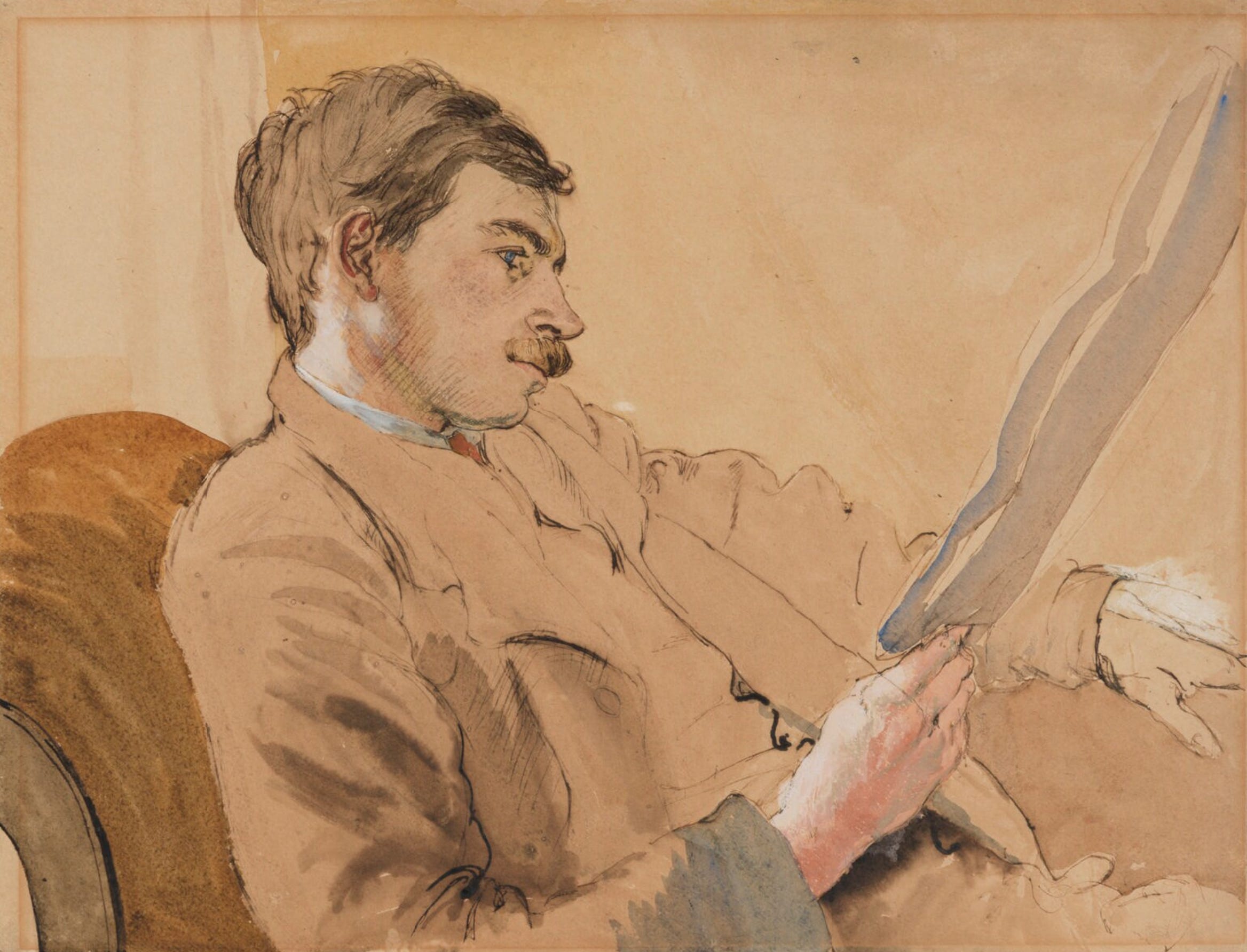
John Maynard Keynes, “The Influence of Furniture on Love,” West 86th: A Journal of Decorative Arts, Design History, and Material Culture 24, no. 1, 2017, 109.
110.
111.
John Maynard Keynes. The General Theory of Employment, Interest and Money. Macmillan, 1936, 9.
“The Influence of Furniture on Love,” 111.