This image is very calm
Jane B. par Agnès V

This image is very calm,
timeless,
motionless.
Yet time seems to be passing,
drop by drop.
Each minute,
each second,
weeks,
years,
I distinctly remember…
Jane B. par Agnès V. is a 1988 film, made by Agnès Varda for Jane Birkin. It is a life-portrait, which Varda filmed over the course of a year—for the duration of its production, she lived in Birkin’s house, and made its contiguous twin piece—Kung-Fu Master, in which Birkin falls in love with her daughter’s 15-year-old friend.
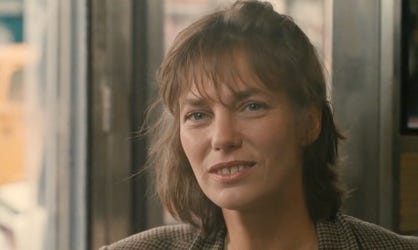
I’ve noticed, Varda begins, in photos and interviews, you never look at the camera. Why?
Birkin laughs and leans back in her chair. I don’t like the hole! She says. Through the window behind her, we can see the streets of Paris.
Look at it.
It’s embarrassing.
Why?
It’s too personal. Like staring at someone. And she looks straight into the camera.
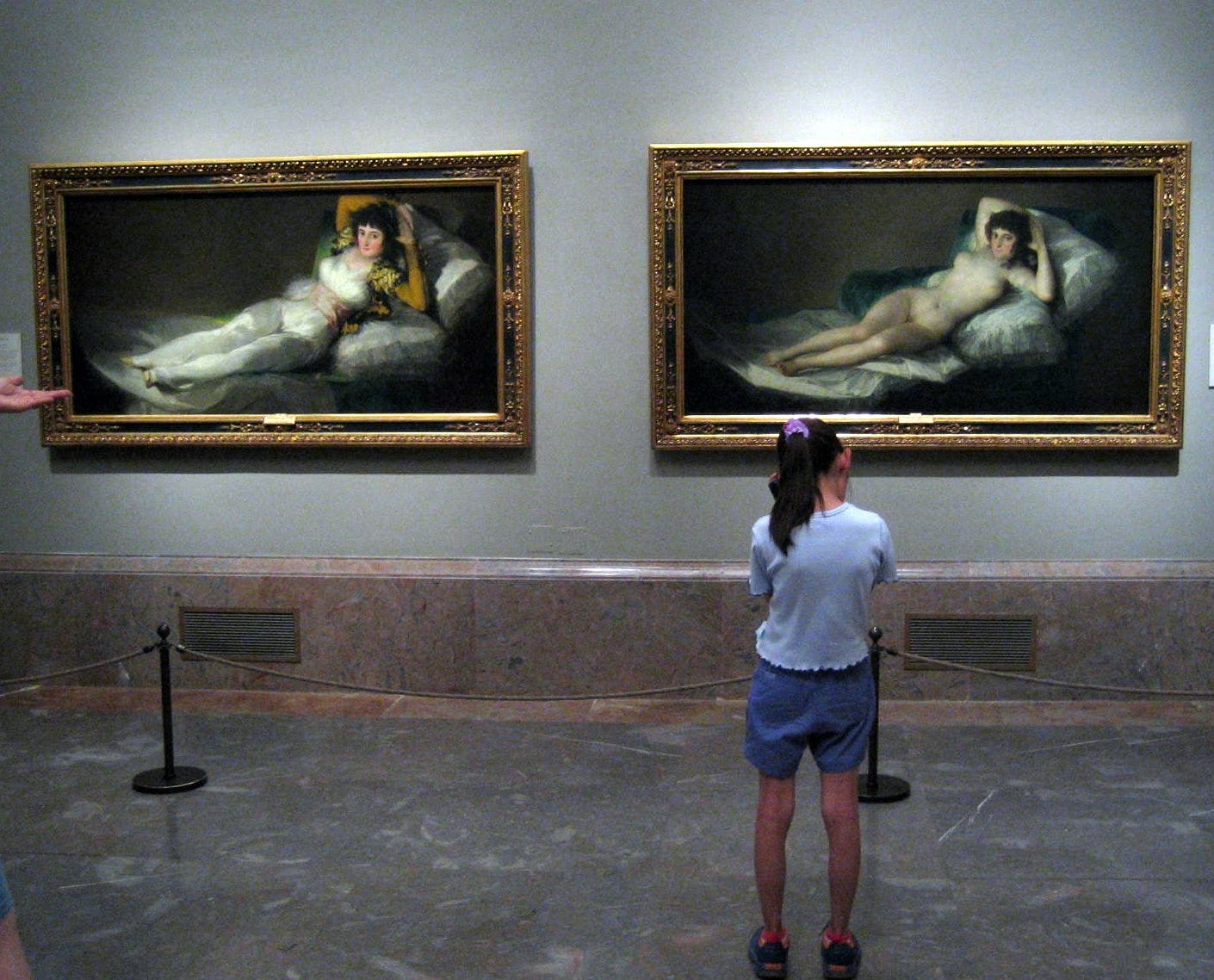
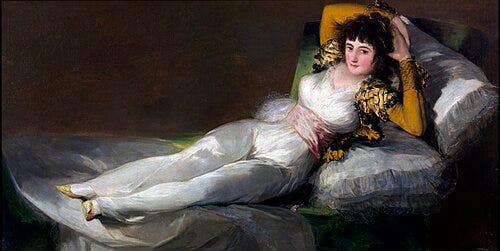
La maja desnuda [The naked Maja, 1797–1800] and La maya vestida [The clothed Maja, 1800–05] are both paintings by Francisco de Goya. Varda has Birkin replicate them.
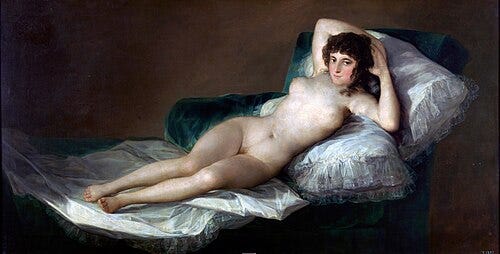
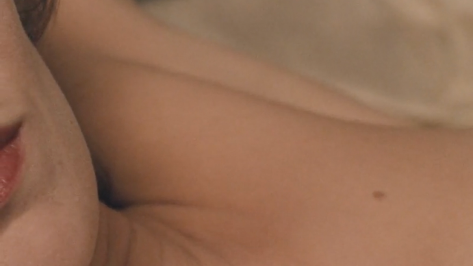
When she is naked, the camera moves along the line of her outstretched body; her toes, to her nipples, to her just-smiling mouth. You feel that Varda must really love her, love her beauty, to film it like this.
When Birkin is clothed, you notice first the darkness of her pubic hair beneath white gauze. In Goya’s representation, this was the feature which forced the paintings into public infamy—the female nude wasn’t meant to be hairy.
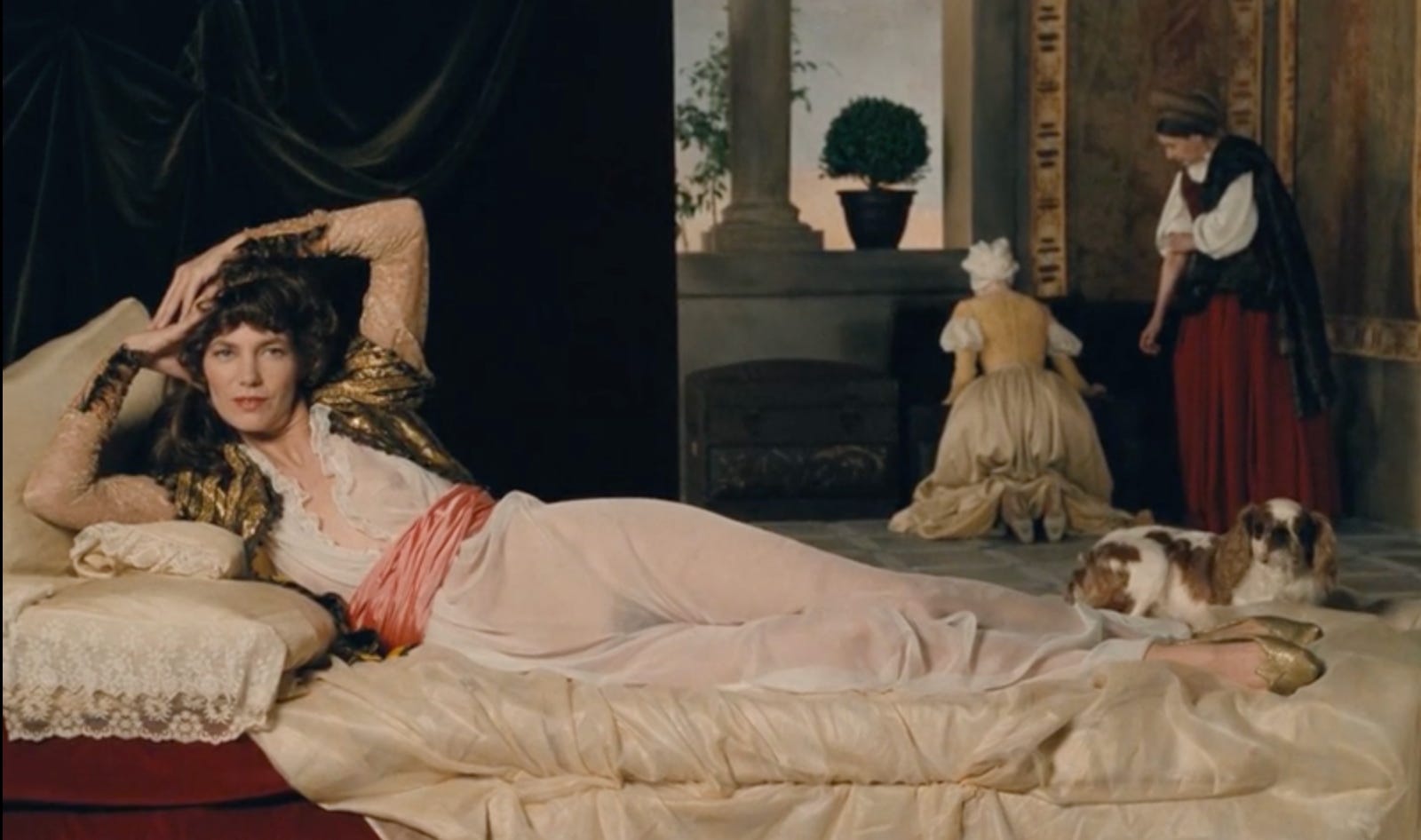
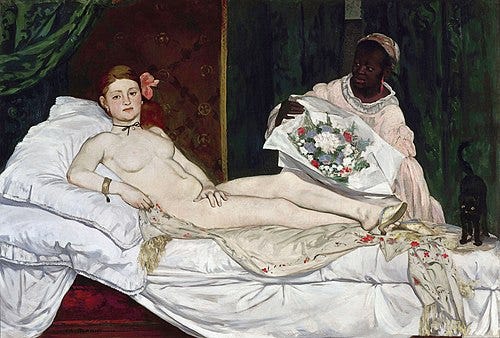
In Varda’s recreation, Birkin is also Titian’s Venus of Urbino (1534), with female servants tending to her background. Titian’s nude is, like Goya’s, infamous—in this case, for the position of his model’s hand; for the intimation that this might not be modesty, that she might be touching herself. Touching herself while—unlike her antecedent, the Dresden Venus (c. 1510)—looking at us. Her gaze is less straightforward than that of Manet’s Olympia (1863), less ironic than that of Maja; it remains a little coy, and soft. More inviting.
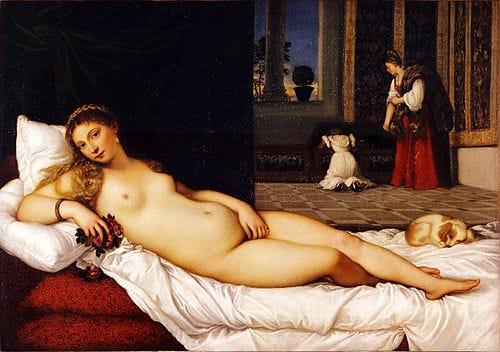
Later in the film, Birkin will switch positions and become one of these other women, trawling in the background. This isn’t, I think, just an invocation of the ‘invisible’ working woman—although it is that too. It is more a representation of the fact that the body which lies there doesn’t only exist in relation to the eye of the painter, who is a man. She must also exist through the dispersed vision of other women. Otherwise, she couldn’t be created as icon.
Varda can maintain the intersection of the icon and the real because she understands this relationship between Birkin and other women—the ones who imitate, but who will-not-be-her. The imitators, sad as we are, are privy to a kind of freedom—not feeling the press of our own naked image, and being able to labour on an object which isn’t all deadening self-representation, or mystification.
Without memory, this would be a total death; Birkin’s head now appears in front of a slideshow of childhood photographs. I wanted to be like my big brother Andrew. My sister Linda was more girlish. She was pretty. Once they disguised me as a girl to give flowers to the queen.
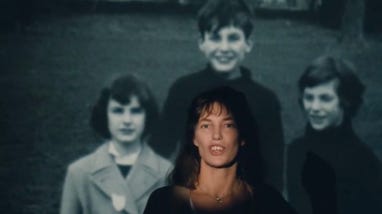
We see images of her first marriage, first film role, then Gainsbourg; Je t’aime…moi non plus begins to play as she walks towards us from the Eiffel Tower. Now alive and moving, the camera pans out, and we see that she is sitting next to an African street-vender, who is selling jewellery from a splayed scarf. Varda asks her to empty the bag; she tips it out, and it is beautiful with loose papers and weary black leather. Find anything out…?
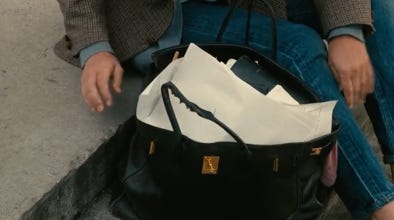
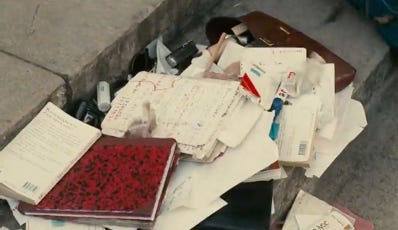
Even when you show it all, Varda replies, you reveal very little. But you were revealed by the men you loved…I can see you as a muse.
I was told Muses never die, but some die of boredom…
At least you’re immortal.
I’m immortal, but dumped! He [Gainsbourg] had the nerve to die young!
Immortal but dumped—Varda remembers,
Once, when I was a teenager, a drowned woman was found in the Seine. She was so beautiful a death mask was made. Copies of the mask were produced. ‘The Unknown Woman of the Seine’ sold well. I bought one.
…Had she been happy to kill herself? Or had someone in the morgue forced her mouth into a smile for the mask?...I wonder if the only true portrait is the death mask. A frontal view of a motionless face. That’s all that remains of someone. A motionless face.
The face of the woman fades, and Birkin fades back in, smiling. And then Varda, sitting seriously, looking at the camera for a few seconds. Looking back at her.
Of Jane Birkin, I know her body best. I know how it looks underneath sheer, cream coloured fabrics; I know how her breasts sit in a tiny dress. This nakedness has a strange relationship to style, to clothing. In Nudities, Agamben says that, nudity belongs to time and history, not to being and form. He means that there is something un-seizable (un-formalisable) about the representation of the naked woman; even when we see her, completely, we look for more nakedness. So we have to freeze the image, stop movement. Sartre reads this desire as an attempt to strip the body of its movements as of its clothes in order to make it exist as pure flesh; it is an attempt to achieve an incarnation of the Other’s body. Movement, he thinks, is the thing which hides the body—more than makeup, clothes, and so forth. This is the thing, though—stopping movement really does create form; like images, or commodities, which are both constituted by, and subject to, fetishism.
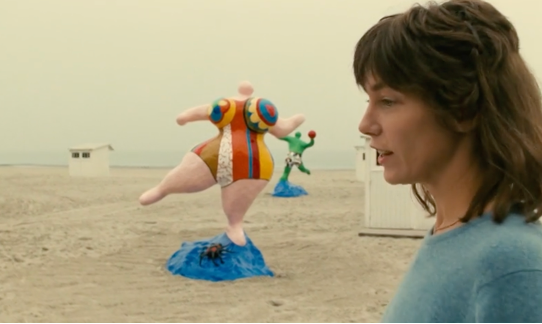
Towards the film’s end, Birkin walks between a beachside installation of Niki de Saint Phalle’s Nana sculptures. Their fleshy, bright-blooming papier-mâché breasts recall her own stuffed school-bra, and subsequent reconciliation, via Gainsbourg, with being flat-chested. Not only did he dislike breasts, he was afraid of them. He liked flat girls, girls he’d sketched at art school.
Defining yourself in opposition is necessary to having an identity at all; on Sunday, I was sitting with you, most beautiful, in the park again. You were vulnerable, tiny, and a precious thing, and I was tough skin. That’s the problem, we said. Where’s the movement between us, I thought we were both.
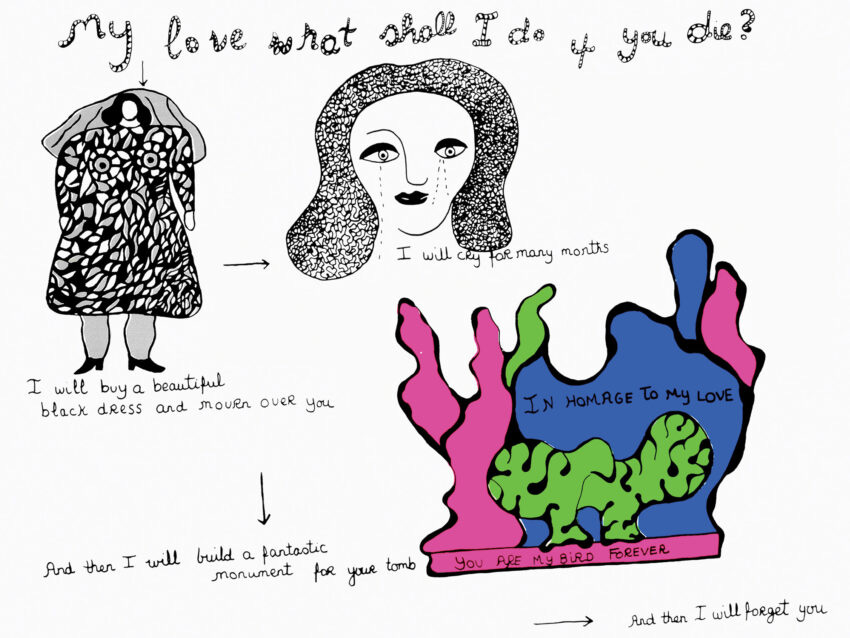
During the 1970s, Saint Phalle wrote a letter to the artist Marína Karélla, in which she recorded a failed suicide attempt:
Dear Marina,
During these years in St. Moritz, I fell in love with a glacier…I must have walked there a hundred times. Then I wrote a film script about it. The subject was an artist and his preoccupation with time, accelerated time, metaphysical time, the merging of times.
In the end, the artist walks onto the glacier, knowing his youth there will be both captured and eternal.
I became fascinated with the idea of committing the perfect suicide…I went for days fantasizing about what would be my last meal. I would take great care to wear lots of very warm clothing, makeup, have my hair done in the afternoon…
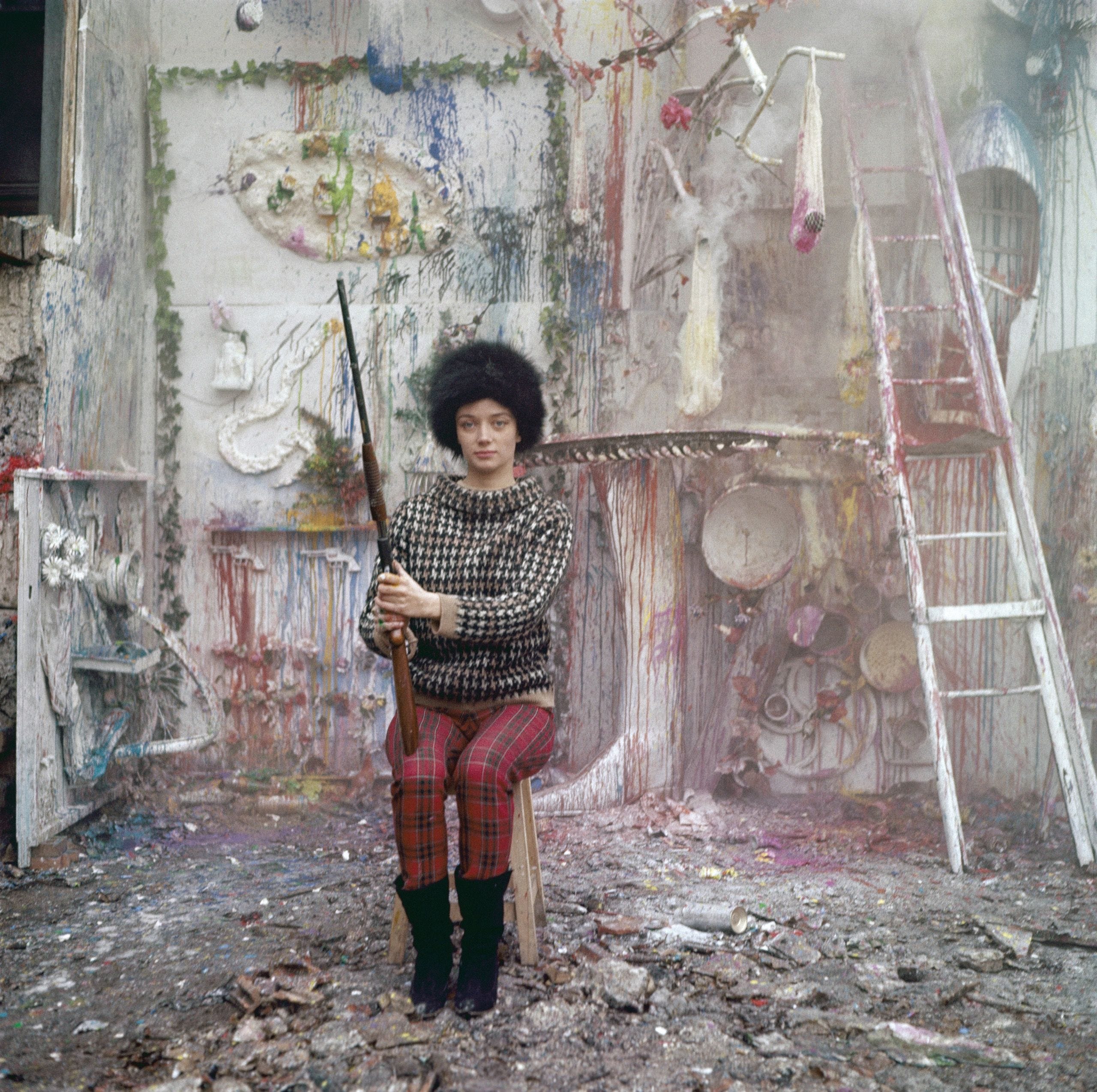
We are naked to nothing more than the executions of time. The appeal of an artist’s suicide, for Saint Phalle, is that the execution comes at the right time; when the subject is young enough to be worth preserving. The image stops, cold.
The Birkin bag is one mystical preservation of the woman herself. As probably the most successful mass-produced luxury commodity of the last century, it is still living. The bag which Birkin tips onto the stairs beneath the Eiffel Tower is not this bag. Her bag, with its papers and overflow, gets to die, because it is made of memory.
Varda understood that filmmaking calls up the deaths of the same people it creates as living. Her portraits are moving, and vivid, because there is only really one line—or four black lines, a frame. A different image, this image is very calm.