Whose Will?
On Nietzsche and Nancy Mitford

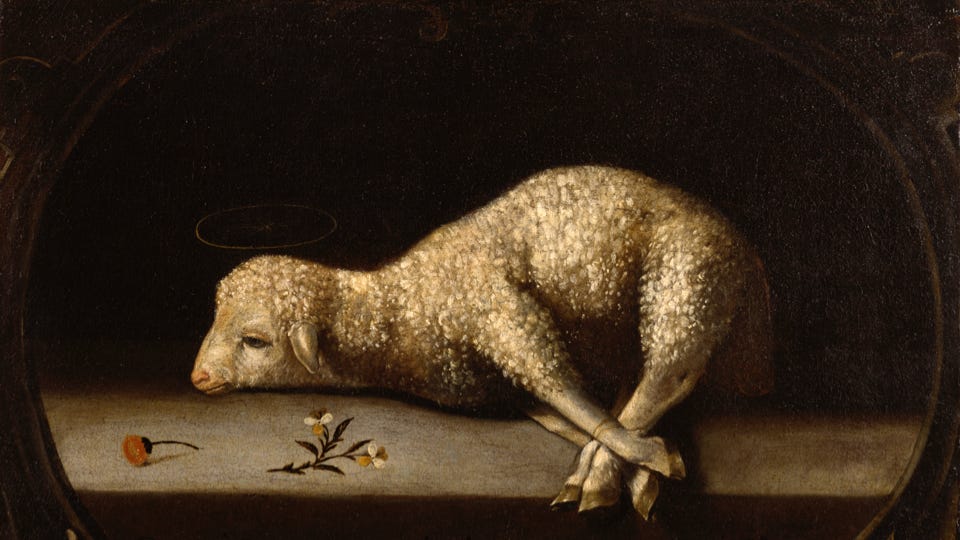
When Friedrich Nietzsche describes ressentiment in On the Genealogy of Morals, he does so with the taste of metal:
— But let us return: the problem of the other origin of ‘good’, of good as thought up by the man of ressentiment, demands its solution. —There is nothing strange about the fact that lambs bear a grudge towards large birds of prey: but that is no reason to blame the large birds of prey for carrying off the little lambs. And if the lambs say to each other, ‘These birds of prey are evil; and whoever is least like a bird of prey and most like its opposite, a lamb, —is good, isn’t he?’, then there is no reason to raise objections to this setting-up of an ideal beyond the fact that the birds of prey will view it somewhat derisively, and will perhaps say: ‘We don’t bear any grudge at all towards these good lambs, in fact we love them, nothing is tastier than a tender lamb.’1
Ressentiment can be distinguished from quotidian resentment by its relation to vengeance—a desire for retribution which seeks an eagle’s eye for one of the lamb’s, etc. Vengeful desire also has the greater danger of being ontologised, as I look to make ressentiment essential to the self-concept of my own existence. I have suffered, this is fundamental to who I am, my suffering must be issued back, towards my abusers. Most importantly, ressentiment allows me to condemn all the world, while keeping myself unscathed.
*
Nancy Mitford’s The Pursuit of Love (1945) is not an ontologically resentful book. Its heroine, Linda Radlett, is too sovereign, moves with too much enthusiasm, for any such bitter seed to grow. We begin with an image of Linda’s family, as recalled by our narrator, their drab cousin Fanny:
There is a photograph in existence of Aunt Sadie and her six children sitting round the tea-table at Alconleigh…There they are, held like flies, in the amber of that moment—click goes the camera and on goes life; the minutes, the days, the years, the decades, taking them further and further from that happiness and promise of youth, from the hopes Aunt Sadie must have had for them, and from the dreams they dreamed for themselves. I often think there is nothing so poignantly sad as old family groups.2
It’s impossible to replicate the richness with which Mitford represents these early scenes of childhood at the aristocratic homestead of Alconleigh; as that, they are almost unequalled in Anglophone literature. For novelists working in this tradition, there is one major question: how will they reconstruct the movement between intimacy and alienation (with reader, themselves, and world)? In The Pursuit of Love, her masterpiece, Mitford lands on the side of intimacy, with some veneer of cool separation. For this, she is often compared to her close friend, Evelyn Waugh—but Waugh’s edges cut quite different shapes.
Linda Radlett, like Mitford herself, is born into the English aristocracy and comes of age between the wars. She is ‘a delicate, as well as a highly nervous child’—as, following the death of her cousin’s pet mouse, ‘Enormous tears [poured] into Linda’s plate. Nobody cried so much or so often as she’.3
She is not structurally morose, however, as these
…tears would be forgotten as if they had never been…The Radletts were always either on a peak of happiness or drowning in black waters of despair; their emotions were on no ordinary plane, they loved or they loathed, they laughed or they cried, they lived in a world of superlatives.4
This is not to say that Linda is without private sorrows—Mitford’s genius, however, is in the fact that we are never shown them. She is, most wonderfully, tough. Through all the erring course of Linda’s life, through failed love affairs, war, and familial betrayals, she refuses to ontologise the pain of failure into bitterness.
Similarly, Mitford’s light-seeming style offers its characters something like affectionate, ironic forgiveness (without ever forgetting their many, many sins). At its best, her transformation of shredded life into comedy has something of Jane Austen’s genius—in which, Virginia Woolf once wrote, ‘each movement must tell to the utmost…bound…denied the relief of all hints, repetitions, suggestions.’5 ‘It is thus,’ Woolf wrote,
with a thousand differences of degree, that in English Literature Jane Austen writes a novel. There comes a moment, “I will dance with you,” says Emma—which rises higher than the rest, which, though not eloquent in itself, or violent, or made striking by beauty of language, has the whole weight of the book behind it.
This weight comes from a sense of determinacy, from the ‘ligatures’ which surround her characters; they are ‘bound, and restricted to a few definite movements…[Austen], in her modest, everyday prose, chose the dangerous art where one slip means death.’6
As Bridie had said, in the elevator-shaft smokers—‘Of course, everything can be forgiven.’ Then, almost winking. ‘But nothing is forgotten.’
That’s exactly right, I said, leaning forward happily. Nothing is forgotten.
*
And that is why The Pursuit of Love is a comedy—all the erring and real terrors of Linda’s inimitable life will be reconciled into her continuous, messy affirmation of life itself—while remaining a formal problem for the author herself (whose life it is, too).
This affirmation is best expressed in Linda’s paratactic speech. Here she is, describing her second husband, Christian, who she has briskly and unwisely fallen in love with while married to her first:
‘Well, he’s heaven. He’s a frightfully serious man, you know, a Communist, and so am I now, and we are surrounded by comrades all day…The comrades don’t like anarchists, isn’t it queer? I always thought they were the same thing, but Christian likes this one because he threw a bomb at the King of Spain; you must say it’s romantic.’
Fanny, our narrator, interjects: ‘Yes, but darling, tell about Christian.’
‘Oh, he’s perfect heaven…You can’t think what an extraordinary man he is, so detached from other human beings that he hardly notices whether they are there or not. He only cares for ideas.’7
The entanglement ends badly, as Christian enters the Spanish Civil War, falls in love with a more sensible woman, and Linda finds herself stranded at the Gare du Nord. There, she chances upon a French Duke, Fabrice, and becomes his mistress. She will die, at the end of the book, during the birth of their son. Her death is sudden, matter-of-fact, and without foreshadowing:
The doctors who said that Linda ought never to have another child were not such idiots after all. It killed her. She died, I think, completely happy, and without having suffered very much, but for us at Alconleigh…a light went out, a great deal of joy that could never be replaced.8
Linda feels no prior awareness of her own death. She does, however, dwell on the shared death of her generation; their absorption into history. As Fanny observes,
Her mind was entirely on the past.
‘It’s rather sad,’ she said one day, ‘to belong, as we do, to a lost generation. I’m sure in history the two wars will count as one war and that we shall be squashed out of it altogether, and people will forget that we ever existed. We might just as well have never lived at all, I do think it’s a shame.’
‘It may become a sort of literary curiosity,’ Davey said.
…
‘I don’t want to be a literary curiosity,’ said Linda. ‘I should like to have been a living part of a really great generation. I think it’s too dismal to have been born in 1911.’
‘Never mind, Linda, you will be a wonderful old lady.’9
Reading The Pursuit of Love, as Zoë Heller describes so well, we ‘find ourselves glimpsing the skeletons beneath the skins of these gorgeously alive people’.10 This is because Mitford’s lightness of style carries within it all the brevity, changeability and tragedy of seasons. While she has been much-critiqued and dismissed for her ‘brazen indifference to big ideas’, and ‘minute attention to the sex and love lives of the privileged upper class’, it is this attention which makes her characters a study in the exteriorised pursuit of life—even if their interiors are neither ‘fleshed out’, nor made a site of formal experimentation.
We are not given much insight into anyone’s inner lives—indeed, we often suspect that these people are constituted by little more than repeated social engagement and mimicry (and isn’t this the point!—what else could we possibly be?). However, there can be no doubt of their reality, which is made flesh-and-blood in each encounter, every memory of a scene, in drawing room or square. And Linda is more mystery and flesh than any; her foibles are given total clarity, but so too is her naïveté; a naïveté which is complicated by the knowingness of the ‘second Linda’—her author. Linda is more lamb than eagle, repeatedly swept up by the force of terrible feeling, and deserted—and yet, she never falls into the trap of making something like ressentiment the structure of future feeling.
Of course, this is inextricable from her aristocratic upbringing. But, as Gilles Deleuze points out in Nietzsche and Philosophy (1962), ressentiment belongs as much to the ruling class as to the oppressed—to ‘the dominators…once the regime [or epoch] comes under the sway of forces which are reactive.’ He goes on to correct our most common misreading of the will to power:
…If it is true that all things reflect a state of forces then power designates the element, or rather the differential relationship, of forces which directly confront one another….to ‘want or seek power’ is only the lowest degree of the will to power, its negative form, the guise it assumed when reactive forces prevail in the state of things.11
Mitford’s family, filled with some of England’s most virulent fascists, took up a form of reactionary-aristocratic politics which was itself structured by ressentiment—by a desire to freeze experience into identity, and to protect false, whitened innocence from the illusion of infection and decay.
But in refusing to consolidate suffering into identity, Linda renounces innocence and thus remains in motion, via the movement of Mitford’s inimitable, continuous style. The Pursuit of Love, in all its its naïveté and irony, is thus structured by a traceable (and, I think, hopeful) ethical position—by the defence of a life lived without the moral economy of ressentiment as alibi or reward.

Works Cited
Deleuze, Gilles. Nietzsche and Philosophy. Translated by Hugh Tomlinson, Continuum, 2002.
Heller, Zoë. Introduction. The Pursuit of Love. Penguin, 2010.
Mitford, Nancy. The Pursuit of Love. Penguin, 2010.
Nietzsche, Friedrich. On the Genealogy of Morality. Translated by Carol Diethe, Cambridge University Press, 2007.
Woolf, Virginia. Collected Essays, Volume 1. The Hogarth Press, 1966.
Nietzsche, 25.
Mitford, 1.
Mitford, 16.
Mitford, 19.
Woolf, 3.
Woolf, 3.
Mitford, 110.
Mitford, 202.
Mitford, 198–9.
Heller, 10.
Deleuze, x–xi.